| 1619 |
The first African slaves arrive in Virginia. |
| 1773 |
Phillis Wheatley’s book Poems on Various Subjects, Religious and Moral is published, making her the first African American to do so. |
| 1793 |
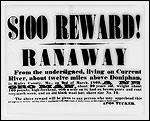
Poster advertising $100 reward for runaway slaves from 1860
A federal fugitive slave law is enacted, providing for the return slaves who had escaped and crossed state lines. |
| 1808 |
Congress bans the importation of slaves from Africa. |
| 1820 |
The Missouri Compromise bans slavery north of the southern boundary of Missouri. |
| 1831 |
Nat Turner, an enslaved African-American preacher, leads the most significant slave uprising in American history. He and his band of followers launch a short, bloody, rebellion in Southampton County, Virginia. The militia quells the rebellion, and Turner is eventually hanged. As a consequence, Virginia institutes much stricter slave laws. |
| 1846 |
Frederick Douglass launches his abolitionist newspaper. |
| 1850 |
The continuing debate whether territory gained in the Mexican War should be open to slavery is decided in the Compromise of 1850: California is admitted as a free state, Utah and New Mexico territories are left to be decided by popular sovereignty, and the slave trade in Washington, DC, is prohibited. It also establishes a much stricter fugitive slave law than the original, passed in 1793. |
| 1854 |
Congress passes the Kansas-Nebraska Act, establishing the territories of Kansas and Nebraska. The legislation repeals the Missouri Compromise of 1820 and renews tensions between anti- and proslavery factions. |
| 1857 |
The Dred Scott case holds that Congress does not have the right to ban slavery in states and, furthermore, that slaves are not citizens. |
| 1859 |
John Brown and 21 followers capture the federal arsenal at Harpers Ferry, Va. (now W. Va.), in an attempt to launch a slave revolt. |
| 1861 |
The Confederacy is founded when the deep South secedes, and the Civil War begins. |
| 1863 |
President Lincoln issues the Emancipation Proclamation, declaring “that all persons held as slaves” within the Confederate states “are, and henceforward shall be free.” |
| 1865 |
Congress establishes the Freedmen’s Bureau to protect the rights of newly emancipated blacks (March).
The Civil War ends (April 9).
Lincoln is assassinated (April 14).
The Ku Klux Klan is formed in Tennessee by ex-Confederates (May).
Slavery in the United States is effectively ended when 250,000 slaves in Texas finally receive the news that the Civil War had ended two months earlier (June 19).
Thirteenth Amendment to the Constitution is ratified, prohibiting slavery (Dec. 6). |
| 1865-1866 |
Black codes are passed by Southern states, drastically restricting the rights of newly freed slaves. |
| 1867 |
A series of Reconstruction acts are passed, carving the former Confederacy into five military districts and guaranteeing the civil rights of freed slaves. |
| 1868 |
Fourteenth Amendment to the Constitution is ratified, defining citizenship. Individuals born or naturalized in the United States are American citizens, including those born as slaves. This nullifies the Dred Scott Case (1857), which had ruled that blacks were not citizens. |
| 1869 |
Howard University’s law school becomes the country’s first black law school. |
| 1870 |
Fifteenth Amendment to the Constitution is ratified, giving blacks the right to vote.
Hiram Revels of Mississippi is elected the country’s first African-American senator. During Reconstruction, sixteen blacks served in Congress and about 600 served in states legislatures. |
| 1877 |
Reconstruction ends in the South. Federal attempts to provide some basic civil rights for African Americans quickly erode. |
| 1881 |
Spelman College, the first college for black women in the U.S., is founded by Sophia B. Packard and Harriet E. Giles.
Booker T. Washington founds the Tuskegee Normal and Industrial Institute in Alabama. |
| 1882 |
The American Colonization Society, founded by Presbyterian minister Robert Finley, establishes the colony of Monrovia (which would eventually become the country of Liberia) in western Africa. The society contends that the immigration of blacks to Africa is an answer to the problem of slavery as well as to what it feels is the incompatibility of the races. Over the course of the next forty years, about 12,000 slaves are voluntarily relocated. |
| 1896 |
Plessy v. Ferguson: This landmark Supreme Court decision holds that racial segregation is constitutional, paving the way for the repressive Jim Crow laws in the South. |
| 1909 |
The National Association for the Advancement of Colored People is founded in New York. |
| 1920s |
The Harlem Renaissance flourishes in the 1920s and 1930s. This literary, artistic, and intellectual movement fosters a new black cultural identity. |
| 1947 |
Jackie Robinson breaks Major League Baseball’s color barrier when he is signed to the Brooklyn Dodgers by Branch Rickey. |
| 1948 |
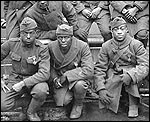
WWI Black Soldiers
Although African Americans had participated in every major U.S. war, it was not until after World War II that President Harry S. Truman issues an executive order integrating the U.S. armed forces. |
| 1952 |
Malcolm X becomes a minister of the Nation of Islam. Over the next several years his influence increases until he is one of the two most powerful members of the Black Muslims (the other was its leader, Elijah Muhammad). A black nationalist and separatist movement, the Nation of Islam contends that only blacks can resolve the problems of blacks. |
| 1954 |
Brown v. Board of Education of Topeka, Kans. declares that racial segregation in schools is unconstitutional (May 17). |
| 1955 |
A young black boy, Emmett Till, is brutally murdered for allegedly whistling at a white woman in Mississippi. Two white men charged with the crime are acquitted by an all-white jury. They later boast about committing the murder. The public outrage generated by the case helps spur the civil rights movement (Aug.).
Rosa Parks refuses to give up her seat at the front of the “colored section” of a bus to a white passenger (Dec.1). In response to her arrest Montgomery’s black community launch a successful year-long bus boycott. Montgomery’s buses are desegregated on Dec. 21, 1956. |
| 1957 |
Nine black students are blocked from entering the school on the orders of Governor Orval Faubus. (Sept. 24). Federal troops and the National Guard are called to intervene on behalf of the students, who become known as the “Little Rock Nine.” Despite a year of violent threats, several of the “Little Rock Nine” manage to graduate from Central High. |
| 1960 |
Four black students in Greensboro, North Carolina, begin a sit-in at a segregated Woolworth’s lunch counter (Feb. 1). Six months later the “Greensboro Four” are served lunch at the same Woolworth’s counter. The event triggers many similar nonviolent protests throughout the South. |
| 1961 |
Over the spring and summer, student volunteers begin taking bus trips through the South to test out new laws that prohibit segregation in interstate travel facilities, which includes bus and railway stations. Several of the groups of “freedom riders,” as they are called, are attacked by angry mobs along the way. The program, sponsored by The Congress of Racial Equality (CORE) and the Student Nonviolent Coordinating Committee (SNCC), involves more than 1,000 volunteers, black and white. |
| 1963 |
The March on Washington for Jobs and Freedom is attended by about 250,000 people, the largest demonstration ever seen in the nation’s capital. Martin Luther King delivers his famous “I Have a Dream” speech. The march builds momentum for civil rights legislation (Aug. 28).
Four young black girls attending Sunday school are killed when a bomb explodes at the Sixteenth Street Baptist Church, a popular location for civil rights meetings. Riots erupt in Birmingham, leading to the deaths of two more black youths (Sept. 15). |
| 1964 |
President Johnson signs the Civil Rights Act, the most sweeping civil rights legislation since Reconstruction. It prohibits discrimination of all kinds based on race, color, religion, or national origin (July 2).
The bodies of three civil-rights workers are found. Murdered by the KKK, James E. Chaney, Andrew Goodman, and Michael Schwerner had been working to register black voters in Mississippi (Aug.).
Martin Luther King receives the Nobel Peace Prize. (Oct.) |
| 1965 |
Malcolm X, black nationalist and founder of the Organization of Afro-American Unity, is assassinated (Feb. 21)
Congress passes the Voting Rights Act of 1965, making it easier for Southern blacks to register to vote. Literacy tests, poll taxes, and other such requirements that were used to restrict black voting are made illegal (Aug. 10).
In six days of rioting in Watts, a black section of Los Angeles, 35 people are killed and 883 injured (Aug. 11-16). |
| 1966 |
The Black Panthers are founded by Huey Newton and Bobby Seale (Oct.). |
| 1967 |
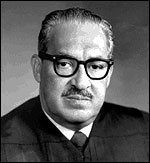
Supreme Court Justice Thurgood Marshall
Major race riots take place in Newark (July 12-16) and Detroit (July 23-30).
President Johnson appoints Thurgood Marshall to the Supreme Court. He becomes the first black Supreme Court Justice.
The Supreme Court rules in Loving v. Virginia that prohibiting interracial marriage is unconstitutional. Sixteen states still have anti-miscegenation laws and are forced to revise them. |
| 1968 |
Martin Luther King, Jr., is assassinated in Memphis, Tenn. (April 4).
President Johnson signs the Civil Rights Act of 1968, prohibiting discrimination in the sale, rental, and financing of housing (April 11). |
| 1972 |
The infamous Tuskegee Syphilis experiment ends. Begun in 1932, the U.S. Public Health Service’s 40-year experiment on 399 black men in the late stages of syphilis has been described as an experiment that “used human beings as laboratory animals in a long and inefficient study of how long it takes syphilis to kill someone.” |
| 1992 |
The first race riots in decades erupt in south-central Los Angeles after a jury acquits four white police officers for the videotaped beating of African-American Rodney King (April 29). |
| 2008 |
Sen. Barack Obama, Democrat from Chicago, becomes the first African American to be nominated as a major party nominee for president.
On November 4, Barack Obama, becomes the first African American to be elected president of the United States, defeating Republican candidate, Sen. John McCain. |
| 2009 |
Barack Obama Democrat from Chicago, becomes the first African-American president and the country’s 44th president.
On February 2, the U.S. Senate confirms, with a vote of 75 to 21, Eric H. Holder, Jr., as Attorney General of the United States. Holder is the first African American to serve as Attorney General. |