Union Pacific's Great Excursion Adventure

“I can see… I can see.. I can see… I can see right through you…”

everyday glory, family and friends, geekery, LEGO and Rokenbok, movies and TV, music, news and info, science and technology, travel No Comments »

Friday – 05 March 2010
Happy Birthday to Liz and Jenny, a couple of my high school classmates:

I'm so glad you're conjoined twins so I don't have to send separate birthday cards

…even if you’re not really conjoined.

It’s snowing outside. I have to admit that isn’t doing much for my motivation.

Last night, I spent the evening hanging out with ; she interviewed me for a school project. We had planned to go to Borders… but we discovered that their cafe closes at 1900 during the week. YeahbuhWHAT?! Yeah. I think that qualifies as “lame.” We wound up at the nearby Barnes & Noble, instead… where we ran into an old friend of ‘s. The interview took about a half-hour; after that, we sat and chatted almost two hours away.  It was a good way to spend the evening.

Stray Toasters

There’s a Friday out there; I should go introduce myself to it.

Namaste.

“Don’t push me, cause I’m close to the edge…”

dining and cuisine, everyday glory, family and friends, food for thought, games, movies and TV, music, news and info, office antics, science and technology, sports, toys, zombies No Comments »

Monday – 01 March 2010
There’s an old proverb that says “March comes in like a lion and goes out like a lamb.” Looking outside, it’s sunny and clear – at least as clear as the valley gets when the smog/inversion sets in. It’s supposed to be somewhere around 50F today. If this is a lion, it must be Kimba, the White Lion.

I watched the third period and overtime of the Team U.S.A. vserus Team Canada hockey match for the Olympic gold medal. Wow… That was an excellent game. I can only imagine how dejected the American players were at the loss, but they played very well. Kudos to them one a well-played game.

Last night, Bonne, Logan and Justin came over for dinner – mahi mahi, rice pilaf and salad – and a movie: Dead Snow. Dinner was quite delicious. The movie was… pretty damned good, actually. The synopsis:

A ski vacation turns horrific for a group of medical students, as they find themselves confronted by an unimaginable menace: Nazi zombies.

I think the only thing that they left out of that synopsis was: “Hijinks ensue” or “Mayhem ensues,” either fits.  While it wasn’t necessarily an Oscar-calibre movie, it was entertaining and fun.

Stray Toasters

He knows changes aren’t permanent
But change is…

Namaste.

“Can you feel a brand new day?”

everyday glory, family and friends, food for thought, games, LEGO and Rokenbok, movies and TV, news and info, politics and law, science and technology, Whiskey Tango Foxtrot...?!, zombies No Comments »

Sunday – 28 February 2010
It’s a quiet lazy morning.

The sun’s out. iGoogle says that it’s supposed to be (relatively) warm. To quote an old Kellogg’s commercial: “It’s gonna be a great day!”

Logan, Bonne and possibly Justin are coming over this evening for dinner and to watch Dead Snow:

A ski vacation turns horrific for a group of medical students, as they find themselves confronted by an unimaginable menace: Nazi zombies.

Let’s allow that last part to sink in further: Nazi zombies. How can this movie not be (horribly) good?!

Chew on This: Food for Thought – Black History Month

Today is the last day of February and, as such, the last day of Black History Month in the United States and Canada. Of all the things that we’ve looked at over the past twenty-seven days, one question has not been asked: “Why do we have a Black History Month?”

The remembrance was founded in 1926 by United States historian Carter G. Woodson as “Negro History Week”. Woodson chose the second week of February because it marked the birthdays of two Americans who greatly influenced the lives and social condition of African Americans: former President Abraham Lincoln and abolitionist and former slave Frederick Douglass.

The celebration was expanded to a month in 1976, the nation’s bicentennial. President Gerald R. Ford urged Americans to “seize the opportunity to honor the too-often neglected accomplishments of black Americans in every area of endeavor throughout our history.”

While I believe that it is good to set aside time to recognize the achievements and pitfalls of the past, we still have “…miles to go before [we] sleep.” Black history – and any ethnic group’s history, for that matter – shouldn’t be relegated to just one month of the year. In the same way that America was known as a melting pot of cultures and ethnicities, our history is an amalgamation of those peoples’ struggles and stories. These are things that should be studied and celebrated throughout the year, as a common history of the people of the United States of America.

Stray Toasters

Namaste.

“But it was Saturday night, I guess that makes it alright… You said,’What have I got to lose?’ “

everyday glory, family and friends, food for thought, games, movies and TV, sports No Comments »

Saturday – 27 February 2010
Today has been a good day.

It started off with sleeping in. I was so tired, in fact, that I barely remember SaraRules leaving to go to a Junior League meeting.

That was followed by picking up Chris and then heading up to Dr. Volt’s for today’s HeroClix tournament. I called the event that I ran “All Teams Great and Small…” Players built either a 500 or 1000 point team: If a player built a 500-point team, they would be paired with another 500-point player; if they built a 1000-point team, their build had to include a colossal figure and they fought alone. There were fifteen players, with ten players at 500 points and five at 1000.

After the first round, SaraRules showed up to say “Hi.” I took a few minutes to go and grab lunch at Oh Sushi! Then, it was back to the gaming. I wound up playing “bye” rounds with a 1000-point team of Uncanny X-men:

  • Colossus (Mutations and Monsters)
  • Cyclops (Danger Room; “Astonishing X-Men” repaint)
  • Phoenix (Armor Wars, rookie setting)
  • Professor X (Mutations and Monsters)
  • Storm (Mutations and Monsters)
  • Wolverine (Sinister)

The format was well-received and people seemed to have a fun time.

Back home to get ready to see the Jen (also known as ) and the Treasure Valley Rollergirls take on Midnight Terror:

We got to see Jen briefly at halftime. TVR went on to win the bout!

Quick trip back home so that SaraRules could change… and head back downtown to escort Utah Symphony’s guest artist to this evening’s Vivace event. (Meanwhile, I’m here at home, catching up on 24.)

Chew on This: Food for Thought – Black History Month
As February has 28 days – and the alphabet only has 26 letters – I need something to fill in the last two days of the month. SaraRules suggested a look at a brief timeline of Black History in America. Capital idea!

1619 The first African slaves arrive in Virginia.
1773 Phillis Wheatley’s book Poems on Various Subjects, Religious and Moral is published, making her the first African American to do so.
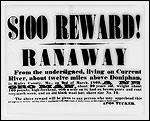
1793

Poster advertising $100 reward for runaway slaves from 1860

Poster advertising $100 reward for runaway slaves from 1860

A federal fugitive slave law is enacted, providing for the return slaves who had escaped and crossed state lines.

1808 Congress bans the importation of slaves from Africa.
1820 The Missouri Compromise bans slavery north of the southern boundary of Missouri.
1831 Nat Turner, an enslaved African-American preacher, leads the most significant slave uprising in American history. He and his band of followers launch a short, bloody, rebellion in Southampton County, Virginia. The militia quells the rebellion, and Turner is eventually hanged. As a consequence, Virginia institutes much stricter slave laws.
1846 Frederick Douglass launches his abolitionist newspaper.
1850 The continuing debate whether territory gained in the Mexican War should be open to slavery is decided in the Compromise of 1850: California is admitted as a free state, Utah and New Mexico territories are left to be decided by popular sovereignty, and the slave trade in Washington, DC, is prohibited. It also establishes a much stricter fugitive slave law than the original, passed in 1793.
1854 Congress passes the Kansas-Nebraska Act, establishing the territories of Kansas and Nebraska. The legislation repeals the Missouri Compromise of 1820 and renews tensions between anti- and proslavery factions.
1857 The Dred Scott case holds that Congress does not have the right to ban slavery in states and, furthermore, that slaves are not citizens.
1859 John Brown and 21 followers capture the federal arsenal at Harpers Ferry, Va. (now W. Va.), in an attempt to launch a slave revolt.
1861 The Confederacy is founded when the deep South secedes, and the Civil War begins.
1863 President Lincoln issues the Emancipation Proclamation, declaring “that all persons held as slaves” within the Confederate states “are, and henceforward shall be free.”
1865 Congress establishes the Freedmen’s Bureau to protect the rights of newly emancipated blacks (March).

The Civil War ends (April 9).

Lincoln is assassinated (April 14).

The Ku Klux Klan is formed in Tennessee by ex-Confederates (May).

Slavery in the United States is effectively ended when 250,000 slaves in Texas finally receive the news that the Civil War had ended two months earlier (June 19).

Thirteenth Amendment to the Constitution is ratified, prohibiting slavery (Dec. 6).

1865-1866 Black codes are passed by Southern states, drastically restricting the rights of newly freed slaves.
1867 A series of Reconstruction acts are passed, carving the former Confederacy into five military districts and guaranteeing the civil rights of freed slaves.
1868 Fourteenth Amendment to the Constitution is ratified, defining citizenship. Individuals born or naturalized in the United States are American citizens, including those born as slaves. This nullifies the Dred Scott Case (1857), which had ruled that blacks were not citizens.
1869 Howard University’s law school becomes the country’s first black law school.
1870 Fifteenth Amendment to the Constitution is ratified, giving blacks the right to vote.

Hiram Revels of Mississippi is elected the country’s first African-American senator. During Reconstruction, sixteen blacks served in Congress and about 600 served in states legislatures.

1877 Reconstruction ends in the South. Federal attempts to provide some basic civil rights for African Americans quickly erode.
1881 Spelman College, the first college for black women in the U.S., is founded by Sophia B. Packard and Harriet E. Giles.

Booker T. Washington founds the Tuskegee Normal and Industrial Institute in Alabama.

1882 The American Colonization Society, founded by Presbyterian minister Robert Finley, establishes the colony of Monrovia (which would eventually become the country of Liberia) in western Africa. The society contends that the immigration of blacks to Africa is an answer to the problem of slavery as well as to what it feels is the incompatibility of the races. Over the course of the next forty years, about 12,000 slaves are voluntarily relocated.
1896 Plessy v. Ferguson: This landmark Supreme Court decision holds that racial segregation is constitutional, paving the way for the repressive Jim Crow laws in the South.
1909 The National Association for the Advancement of Colored People is founded in New York.
1920s The Harlem Renaissance flourishes in the 1920s and 1930s. This literary, artistic, and intellectual movement fosters a new black cultural identity.
1947 Jackie Robinson breaks Major League Baseball’s color barrier when he is signed to the Brooklyn Dodgers by Branch Rickey.
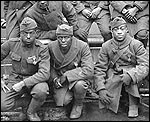
1948

WWI Black Soldiers

WWI Black Soldiers

Although African Americans had participated in every major U.S. war, it was not until after World War II that President Harry S. Truman issues an executive order integrating the U.S. armed forces.

1952 Malcolm X becomes a minister of the Nation of Islam. Over the next several years his influence increases until he is one of the two most powerful members of the Black Muslims (the other was its leader, Elijah Muhammad). A black nationalist and separatist movement, the Nation of Islam contends that only blacks can resolve the problems of blacks.
1954 Brown v. Board of Education of Topeka, Kans. declares that racial segregation in schools is unconstitutional (May 17).
1955 A young black boy, Emmett Till, is brutally murdered for allegedly whistling at a white woman in Mississippi. Two white men charged with the crime are acquitted by an all-white jury. They later boast about committing the murder. The public outrage generated by the case helps spur the civil rights movement (Aug.).

Rosa Parks refuses to give up her seat at the front of the “colored section” of a bus to a white passenger (Dec.1). In response to her arrest Montgomery’s black community launch a successful year-long bus boycott. Montgomery’s buses are desegregated on Dec. 21, 1956.

1957 Nine black students are blocked from entering the school on the orders of Governor Orval Faubus. (Sept. 24). Federal troops and the National Guard are called to intervene on behalf of the students, who become known as the “Little Rock Nine.” Despite a year of violent threats, several of the “Little Rock Nine” manage to graduate from Central High.
1960 Four black students in Greensboro, North Carolina, begin a sit-in at a segregated Woolworth’s lunch counter (Feb. 1). Six months later the “Greensboro Four” are served lunch at the same Woolworth’s counter. The event triggers many similar nonviolent protests throughout the South.
1961 Over the spring and summer, student volunteers begin taking bus trips through the South to test out new laws that prohibit segregation in interstate travel facilities, which includes bus and railway stations. Several of the groups of “freedom riders,” as they are called, are attacked by angry mobs along the way. The program, sponsored by The Congress of Racial Equality (CORE) and the Student Nonviolent Coordinating Committee (SNCC), involves more than 1,000 volunteers, black and white.
1963 The March on Washington for Jobs and Freedom is attended by about 250,000 people, the largest demonstration ever seen in the nation’s capital. Martin Luther King delivers his famous “I Have a Dream” speech. The march builds momentum for civil rights legislation (Aug. 28).

Four young black girls attending Sunday school are killed when a bomb explodes at the Sixteenth Street Baptist Church, a popular location for civil rights meetings. Riots erupt in Birmingham, leading to the deaths of two more black youths (Sept. 15).

1964 President Johnson signs the Civil Rights Act, the most sweeping civil rights legislation since Reconstruction. It prohibits discrimination of all kinds based on race, color, religion, or national origin (July 2).

The bodies of three civil-rights workers are found. Murdered by the KKK, James E. Chaney, Andrew Goodman, and Michael Schwerner had been working to register black voters in Mississippi (Aug.).

Martin Luther King receives the Nobel Peace Prize. (Oct.)

1965

Malcolm X, black nationalist and founder of the Organization of Afro-American Unity, is assassinated (Feb. 21)

Congress passes the Voting Rights Act of 1965, making it easier for Southern blacks to register to vote. Literacy tests, poll taxes, and other such requirements that were used to restrict black voting are made illegal (Aug. 10).

In six days of rioting in Watts, a black section of Los Angeles, 35 people are killed and 883 injured (Aug. 11-16).

1966 The Black Panthers are founded by Huey Newton and Bobby Seale (Oct.).
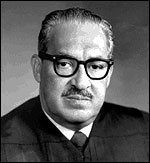
1967

Thurgood Marshall

Supreme Court Justice Thurgood Marshall

Major race riots take place in Newark (July 12-16) and Detroit (July 23-30).

President Johnson appoints Thurgood Marshall to the Supreme Court. He becomes the first black Supreme Court Justice.

The Supreme Court rules in Loving v. Virginia that prohibiting interracial marriage is unconstitutional. Sixteen states still have anti-miscegenation laws and are forced to revise them.

1968 Martin Luther King, Jr., is assassinated in Memphis, Tenn. (April 4).

President Johnson signs the Civil Rights Act of 1968, prohibiting discrimination in the sale, rental, and financing of housing (April 11).

1972 The infamous Tuskegee Syphilis experiment ends. Begun in 1932, the U.S. Public Health Service’s 40-year experiment on 399 black men in the late stages of syphilis has been described as an experiment that “used human beings as laboratory animals in a long and inefficient study of how long it takes syphilis to kill someone.”
1992 The first race riots in decades erupt in south-central Los Angeles after a jury acquits four white police officers for the videotaped beating of African-American Rodney King (April 29).
2008 Sen. Barack Obama, Democrat from Chicago, becomes the first African American to be nominated as a major party nominee for president.

On November 4, Barack Obama, becomes the first African American to be elected president of the United States, defeating Republican candidate, Sen. John McCain.

2009 Barack Obama Democrat from Chicago, becomes the first African-American president and the country’s 44th president.

On February 2, the U.S. Senate confirms, with a vote of 75 to 21, Eric H. Holder, Jr., as Attorney General of the United States. Holder is the first African American to serve as Attorney General.

It’s late; no ‘Toasters tonight.

Namaste.

“What’s your favorite color, baby? Living Colour!”

comics and animation, dining and cuisine, everyday glory, family and friends, monkeys!, movies and TV, news and info, office antics, science and technology, style No Comments »

Friday – 26 February 2010
It’s my 9/80 “on” Friday.
And I’m dealing with an off-site user’s computer issues.  Actually, I’m really just on the phone listening while a guy from corporate IT is trying to step him through a possible resolution. But, since I initiated the third-party call, I can’t just hang up. Yay.

Last night was a quiet night in. After work, I picked up my four-color goodness for the week. And I read the books. And it was good. Selah.  (Details can be found a little later today over on Four-Color Coverage.)

This morning is bright and sunny, with a little bit of haze. That’s not a bad way to kick off the weekend.

Chew on This: Food for Thought – Black History Month
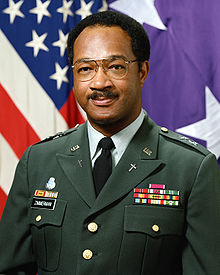
Our A-to-Z look at Black History closes out with Major General Matthew A. Zimmerman, Jr.

General Zimmerman was the first African-American Chief of the United States Army Chaplain Corps.

Matthew Zimmerman lived a life many children would find difficult to enjoy. Born in Rock Hill in 1941, his father was principal of his school and minister of his church. His mother was his first grade teacher.

“My parents, however, were my inspiration, especially my dad. They taught me spiritual values and the importance of building good relationships.”

Zimmerman graduated as valedictorian from Sims High School in Union County. He  entered Benedict College at age 16, graduating with a degree in chemistry and with plans to go to medical school. “At the time I graduated from college, Duke University was offering fellowships to encourage black students to attend their university,” Zimmerman recalls. “I decided to attend Duke and then to go to medical school. Once I started studying at the seminary, though, I decided I wanted to be ordained as a minister.”

Zimmerman became the first African-American student to graduate with a master of divinity degree from Duke University. He was ordained by the National Baptist Convention, Inc., USA and began serving as a campus pastor at universities and colleges throughout the country. Later, he received a master of science degree in guidance and counseling from Long Island University in New York.

In 1967, he entered into military service and was commissioned captain by direct appointment. Shortly after becoming a chaplain, Zimmerman served in Vietnam; he also served in Panama, Grenada and in the Desert Storm campaign. On April 13, 1989, President Bush nominated Zimmerman for promotion to brigadier general. Following confirmation by the United States Senate, he was appointed deputy chief of chaplains of the United States Army. The following year, he was promoted to major general and appointed chief of chaplains, the first African-American to hold this position.

As the chief of chaplains of the US Army, he oversaw 2,800 active duty Reserve and National Guard chaplains and 2,800 chaplain assistants stationed with troops worldwide.

“In the Army there are 92 different denominations represented on active duty by chaplains… We have 39 female chaplains, including a female rabbi. All of our chaplains have to minister to people of all persuasions, but they don’t have to perform a specific event, such as a wedding or other sacraments. However, they are responsible for finding religious personnel to perform specific ceremonies.”

Zimmerman credits his family and years of college ministry in preparing him for working with people of different background. “It is important for students to realize that there are many different cultures. They need to learn to accept people as individuals,” Zimmerman says.

Stray Toasters

Namaste.

“O-E-O-E-O!”

arts and leisure, everyday glory, family and friends, food for thought, games, geekery, monkeys!, news and info, office antics, style, Whiskey Tango Foxtrot...?! No Comments »

Wednesday – 24 February 2010
Happy Birthday to :

Happy birthday to a white person born during Black History Month

Today would ordinarily be Comics and Sushi Wednesday, but I’m in the south office again today. So, I’m just going to combine things and make tomorrow NBN Comics (and maybe Sushi) Thursday. Win-Win(-Win).

Chew on This: Food for Thought – Black History Month
Today, we shine the spotlight on Malcolm X:

Malcolm X – born Malcolm Little, and also known as El-Hajj Malik El-Shabazz – was an African-American Muslim minister, public speaker, and human rights activist.

Born in Nebraska, while an infant Malcolm moved with his family to Lansing, Mich. When Malcolm was six years old, his father, the Rev. Earl Little, a Baptist minister and former supporter of the early black nationalist leader Marcus Garvey, died after being hit by a streetcar; his father’s lessons concerning black pride and self-reliance and his own experiences concerning race, played a significant role in Malcolm’s adult life. After his mother was committed to an insane asylum in 1939, Malcolm and his siblings were sent to foster homes or to live with family members.

Malcolm attended school in Lansing, Mich., but dropped out in the eighth grade when one of his teachers told him that he should become a carpenter instead of a lawyer. Years later, Malcolm would laugh about the incident, but at the time it was humiliating — It made him feel that there was no place in the white world for a career-oriented black man, no matter how smart he was. Malcolm  became involved in hustling and other criminal activities in Boston and New York.

In 1943, the U.S. draft board ordered Little to register for military service. He later recalled that he put on a display to avoid the draft. Military physicians classified him as “mentally disqualified for military service”. He was issued a 4-F card, relieving him of his service obligations.

In 1946, Malcolm  was sentenced to eight to ten years in prison. While in prison for robbery from 1946 to 1952, he underwent a conversion that eventually led him to join the Nation of Islam, an African American movement that combined elements of Islam with black nationalism. Following Nation tradition, he replaced his surname, “Little,” with an “X,” a custom among Nation of Islam followers who considered their family names to have originated with white slaveholders. On August 7, 1952, Malcolm X was paroled and was released from prison. He later reflected on the time he spent in prison after his conversion: “Months passed without my even thinking about being imprisoned. In fact, up to then, I had never been so truly free in my life.

After his release from prison Malcolm helped to lead the Nation of Islam during the period of its greatest growth and influence. He met Elijah Muhammad in Chicago in 1952 and then began organizing temples for the Nation in New York, Philadelphia, and Boston and in cities in the South. For nearly a dozen years, he was the public face of the Nation of Islam; Malcolm X promoted the Nation’s teachings – he taught that black people were the original people of the world, and that white people were a race of devils. In his speeches, Malcolm X said that black people were superior to white people, and that the demise of the white race was imminent.

While the civil rights movement fought against racial segregation, Malcolm X advocated the complete separation of African Americans from white people. He proposed the establishment of a separate country for black people as an interim measure until African Americans could return to Africa. Malcolm X also rejected the civil rights movement’s strategy of nonviolence and instead advocated that black people use any necessary means of self-defense to protect themselves. Many white people, and some blacks, were alarmed by Malcolm X and the things he said. He and the Nation of Islam were described as hatemongers, black segregationists, violence-seekers, and a threat to improved race relations. Civil rights organizations denounced Malcolm X and the Nation as irresponsible extremists whose views were not representative of African Americans.

Malcolm X was equally critical of the civil rights movement. He described its leaders as “stooges” for the white establishment and said that Martin Luther King, Jr. was a “chump”. He criticized the 1963 March on Washington, which he called “the farce on Washington”. He said he did not know why black people were excited over a demonstration “run by whites in front of a statue of a president who has been dead for a hundred years and who didn’t like us when he was alive”.

In 1963 there were deep tensions between Malcolm and Eiljah Muhammad over the political direction of the Nation. Malcolm urged that the Nation become more active in the widespread civil rights protests instead of just being a critic on the sidelines. Muhammad’s violations of the moral code of the Nation further worsened his relations with Malcolm.

Malcolm left the Nation in March 1964 and in the next month founded Muslim Mosque, Inc. During his pilgrimage to Mecca that same year, he experienced a second conversion and embraced Sunni Islam, adopting the Muslim name el-Hajj Malik el-Shabazz. Renouncing the separatist beliefs of the Nation, he claimed that the solution to racial problems in the United States lay in orthodox Islam.

The growing hostility between Malcolm and the Nation led to death threats and open violence against him. On Feb. 21, 1965, Malcolm was assassinated while delivering a lecture at the Audubon Ballroom in Harlem; three members of the Nation of Islam were convicted of the murder.

Stray Toasters

Experience slips away…
The innocence slips away.

Namaste.

“Open the door, get on the floor, everybody walk the dinosaur…”

everyday glory, food for thought, football, geekery, monkeys!, movies and TV, music, news and info, office antics, travel, Whiskey Tango Foxtrot...?! No Comments »

Tuesday – 23 February 2010
It’s a brisk – but sunny – morning.

Once again, there’s residual achiness from Sunday’s workout. Nothing incapacitating, but it’s there. I’ll hopefully work out the kinks and stretch it out on the next gym excursion.

Meetings!  Yay.

Chew on This: Food for Thought – Black History Month
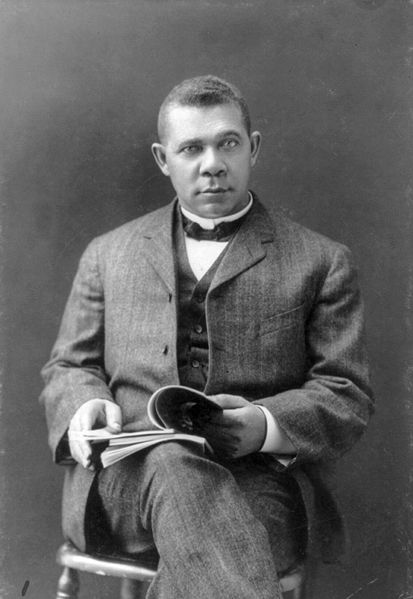
Today’s profile: Booker T. Washington

Booker T. Washington, born Booker Taliaferro, was born in 1856 on the Burroughs tobacco farm (in Virginia) which, despite its small size, he always referred to as a “plantation.” His mother was a cook, his father a white man from a nearby farm. “The early years of my life, which were spent in the little cabin,” he wrote, “were not very different from those of other slaves.”

He went to school in Franklin County – not as a student, but to carry books for one of James Burroughs’s daughters. It was illegal to educate slaves. “I had the feeling that to get into a schoolhouse and study would be about the same as getting into paradise,” he wrote. After emancipation, moved with his family to Malden, W.Va. Dire poverty ruled out regular schooling; at age nine he began working, first in a salt furnace and later in a coal mine. Within a few years, Booker was taken in as a houseboy by a wealthy towns-woman who further encouraged his longing to learn. At age 16, he walked much of the 500 miles back to Virginia to enroll in a new school for black students. He knew that even poor students could get an education at Hampton Institute, paying their way by working. Determined to get an education, he enrolled at the Hampton Normal and Agricultural Institute in Virginia (1872), working as a janitor to help pay expenses. He graduated in 1875 and returned to Malden, where for two years he taught children in a day school and adults at night.

Following studies at Wayland Seminary, Washington, D.C. (1878–79), he joined the staff of Hampton. In 1881, Hampton president Samuel C. Armstrong recommended Washington to become the first leader of Tuskegee Institute, the new normal school (teachers’ college) in Alabama, an institution with two small, converted buildings, no equipment, and very little money. Tuskegee Normal and Industrial Institute became a monument to his life’s work. At his death 34 years later, it had more than 100 well-equipped buildings, some 1,500 students, a faculty of nearly 200 teaching 38 trades and professions, and an endowment of approximately $2,000,000.

Washington the public figure often invoked his own past to illustrate his belief in the dignity of work. “There was no period of my life that was devoted to play,” Washington once wrote. “From the time that I can remember anything, almost everyday of my life has been occupied in some kind of labor.” This concept of self-reliance born of hard work was the cornerstone of Washington’s social philosophy.

Washington received national prominence for his Atlanta Address of 1895, attracting the attention of politicians and the public as a popular spokesperson for African American citizens. Washington built a nationwide network of supporters in many black communities, with black ministers, educators, and businessmen composing his core supporters. Washington played a dominant role in black politics, winning wide support in the black community and among more liberal whites (especially rich northern whites). Many charged that his conservative approach undermined the quest for racial equality. “In all things purely social we can be as separate as the fingers,” he proposed to a biracial audience in his 1895 Atlanta Compromise address, “yet one as the hand in all things essential to mutual progress.” In part, his methods arose for his need for support from powerful whites, some of them former slave owners. It is now known, however, that Washington secretly funded antisegregationist activities.

Despite his travels and widespread work, Washington remained as principal of Tuskegee. Washington’s health deteriorated rapidly; he collapsed in New York City and was brought home to Tuskegee, where he died on November 14, 1915 at the age of 59. The cause of death was unclear, probably from nervous exhaustion and arteriosclerosis. He was buried on the campus of Tuskegee University near the University Chapel.

Stray Toasters

Namaste.

“More human than human…”

arts and leisure, dining and cuisine, everyday glory, family and friends, food for thought, games, geekery, monkeys!, music, news and info, office antics, science and technology, sports, workout No Comments »

Monday – 22 February 2010
“Ugh.”

That, literally, was my first thought upon waking up this morning. It was immediately followed by a line from the chorus of L.T.D.’s Back in Love Again:

Every time I move, I lose

I attribute all of this to the fact that my sides and thighs are achy from yesterday’s workout. Good for me? Yes. Good training? Yes. Builds character? Sure thing.  But, no matter how you spin it, there’s still that pesky “sore from working out” factor to be dealt with. “That which does not kill me,” I guess…

Last night, SaraRules and I (finally) finished off the last two features on the Planet Earth DVDs. Both were pieces about conservation and sustainability. Both were, as with the entire series, done quite well.

Logan and Sanaz came over for a while after dinner. We had coffee and chatted – including a video-chat with Melissa – for a while. It was a nice way to wind down the evening. I also chatted with last night. He regaled me with tales of his excursion with Bot, Bit and Pixel to an Olympic curling event yesterday; I was laughing so much that I was crying. Trying to explain to SaraRules”why” I was laughing so hard was nigh-impossible for a couple of minutes.

Chew on This: Food for Thought – Black History Month
Today’s profile: James Van Der Zee

James Van Der Zee, a leading figure in the Harlem Renaissance, was an African American photographer best known for his portraits of black New Yorkers.

After attending schools in Lenox, he went to New York City (c.1906). Arriving in Harlem as an aspiring violinist, he formed—and performed with—the Harlem Orchestra. From 1909 to 1915 he played in Fletcher Henderson’s band and the John Wanamaker Orchestra (and in an orchestra that accompanied silent films).

On regular return visits from Harlem to his hometown of Lenox, Massachusetts, VanDerZee found himself shooting pictures of the beloved place as a hobby. In 1915 he landed a job as a darkroom technician, and after learning the fundamentals of photography he opened his own studio in Harlem (1916). In 1932, he outgrew his first studio and went on to open the larger GGG Studio, with his second wife as his assistant (since closed, but the building with its original sign can still be seen on the east side of Lenox Avenue between 123rd and 124th Streets in Harlem).

VanDerZee’s work exhibited artistic as well as technical mastery. Thanks to his genius for darkroom experimentation — retouching negatives, for example, and creating double exposures — the demand for his portraiture soon skyrocketed.

Aside from the artistic merits of his work, Van Der Zee produced the most comprehensive documentation of the period.

Although Van Der Zee photographed many of the African American celebrities who passed through Harlem, most of his work was of the straightforward commercial studio variety – weddings and funerals (including pictures of the dead for grieving families), family groups, teams, lodges, clubs, or people simply wanting to have a record of themselves in fine clothes. Many of VanDerZee’s photographs celebrate the life of the emergent black middle class. Using the conventions of studio portrait photography, he composed images that reflected his clients’ dignity, independence, and material comfort, characterizing the time as one of achievement, idealism, and success. VanDerZee’s photographs portray the Harlem of the 1920s and 1930s as a community that managed to be simultaneously talented, spiritual, and prosperous.

National recognition was given to him at age 82, when his collection of 75,000 photographs spanning a period of six decades of African-American life was discovered by the Metropolitan Museum of Art. His photos were featured in 1969 as part of the Harlem on my Mind exhibition. From the 1970s until his death in 1983, Van Der Zee photographed the many celebrities who had come across his work and promoted him throughout the country.

Stray Toasters

Hi-ho, hi-ho…

Namaste.

Sunday ramblings

everyday glory, family and friends, geekery, LEGO and Rokenbok, movies and TV, music, news and info, science and technology, sports, style, toys, workout No Comments »

Sunday – 21 February 2010
Today started out as a lazy day, but it wound up with a little bit of productivity thrown into the mix. I can’t say that’s a bad thing. I slept in this morning, which I didn’t really expect to do. After eating and watching a little Top Gear, SaraRules and I headed to the gym. (That was a good thing.) After the gym, we drove around a bit and scouted a few houses.

And, we still have the rest of the day to do whatever we want.  *nod*

Workout
Today’s workout consisted of:

  • Elliptical: 10 minutes, random program
  • Squats (Smith Press): 3 sets/10 reps, 65 lbs
  • Sit-ups (Incline): 3 sets/20 reps
  • Bench Press: 3 sets/8 reps, 205 lbs
  • Lower Back Extensions: 3 sets/10 reps
  • Reverse Punches: 3 sets/10 reps, 10 lbs
  • Side Bends: 3 sets/10 reps, 10 lbs
  • Curls (Barbell, Reverse grip): 3 sets/10 reps, 50 lbs
  • Overhead Tricep Extensions (Dumbbell): 3 sets/15 reps, 40 lbs
  • Treadmill: 3 minutes

Post-workout weight: 183.5 lbs (13 stone, 1.5 lbs)

Chew on This: Food for Thought – Black History Month
Today’s spotlight isn’t so much a “who” as a series of “whos” and “wheres” – The Underground Railroad.

The Underground Railroad was an informal network of secret routes and safe houses used by 19th century Black slaves in the United States to escape to free states and Canada with the aid of abolitionists who were sympathetic to their cause. It effectively moved hundreds of slaves northward each year — according to one estimate, the South lost 100,000 slaves between 1810 and 1850. Other various routes led to Mexico or overseas.

An organized system to assist runaway slaves seems to have begun towards the end of the 18th century. Churches also often played a role, especially the Religious Society of Friends (Quakers), Congregationalists, Wesleyans, and Reformed Presbyterians as well as certain sects of mainstream denominations such as branches of the Methodist church and American Baptists. In 1786 George Washington complained about how one of his runaway slaves was helped by a “society of Quakers, formed for such purposes.” The system grew, and around 1831 it was dubbed “The Underground Railroad,” after the then emerging steam railroads. The system even used terms used in railroading:

  • People who helped slaves find the railroad were “agents” (or “shepherds”)
  • Guides were known as “conductors”
  • Hiding places were “stations”
  • Abolitionists would fix the “tracks”
  • “Stationmasters” hid slaves in their homes
  • Escaped slaves were referred to as “passengers” or “cargo”
  • Slaves would obtain a “ticket.”
  • Just as in common gospel lore, the “wheels would keep on turning”
  • Financial benefactors of the Railroad were known as “stockholders”.

The Underground Railroad consisted of meeting points, secret routes, transportation, and safe houses, and assistance provided by abolitionist sympathizers. Individuals were often organized in small, independent groups, which helped to maintain secrecy since some knew of connecting “stations” along the route but few details of their immediate area.

For the slave, running away to the North was anything but easy. The first step was to escape from the slaveholder. For many slaves, this meant relying on his or her own resources. Sometimes a “conductor,” posing as a slave, would enter a plantation and then guide the runaways northward. The fugitives would move at night. They would generally travel between 10 and 20 miles to the next station, where they would rest and eat, hiding in barns and other out-of-the-way places. While they waited, a message would be sent to the next station to alert its stationmaster.

The fugitives would also travel by train and boat — conveyances that sometimes had to be paid for. Money was also needed to improve the appearance of the runaways — a black man, woman, or child in tattered clothes would invariably attract suspicious eyes. This money was donated by individuals and also raised by various groups, including vigilance committees.

Due to the risk of discovery, information about routes and safe havens was passed along by word of mouth. Southern newspapers of the day were often filled with pages of notices soliciting information about escaped slaves and offering sizable rewards for their capture and return. Federal marshals and professional bounty hunters known as slave catchers pursued fugitives as far as the Canadian border.

Upon arriving at their destinations, many fugitives were disappointed. While the British colonies had no slavery after 1834, discrimination was still common. Many of the new arrivals had great difficulty finding jobs, in part because of mass European immigration at the time, and overt racism was common.

When frictions between North and South culminated in the American Civil War, many blacks, slave and free, fought with the Union Army.While some later returned to Canada, many remained in the United States. Thousands of others returned to the American South after the war ended. The desire to reconnect with friends and family was strong, and most were hopeful about the changes emancipation and Reconstruction would bring.

Following passage of the Thirteenth Amendment, in some cases the Underground Railroad operated in reverse as fugitives returned to the United States.

Stray Toasters

Yep, that’ll do for now.

Namaste.

Lazy Saturday…

everyday glory, family and friends, food for thought, games, geekery, movies and TV, news and info, politics and law No Comments »

Saturday – 20 February 2010
Today has been a good day… and it’s not even all over yet.

The morning started off a little earlier than I had planned – 0830 – with a text message from loonybin88. Correction: That should have been – “The vacationing loonybin88.” He and his wife (and a couple of coworkers and their wives) are either about to board or have already boarded a cruise ship for a week in the western Caribbean. Nice. But, this morning, he sent the following text:

It is 78 degrees and sunny!
🙂
Just thougtht I would share
.

My response:

It’s 8:30 on a Saturday. I have no children. I have no tournament today. I got to bed after 2:00.  Guess what I was doing.

I’m assuming that it was a multi-recipient text and that – in his… exhuberance… of being on vacation and getting his cruise under way – he neglected to take one tiny (almost insignificant) detail into account: Time zones. He texted me an apology; I told him that it was fine and understandable, but to stop texting and to go have some well-deserved fun! (The man has been busting a serious hump at work; he’s earned this vacation… many times over.)

The morning was kind of lazy. After breakfast, I started work on turning the office into a usable space once again. Oddly, this has had the effect of me making an even larger mess in the name of progress. I interrupted working in the office to go with SaraRules, lj user=”suzie_lightning,” lj user=”everydave”, Mary and Chris to see Shutter Island. Excellent movie… except for some of the editing in “a few” places.

Chew on This: Food for Thought – Black History Month
Today’s profile is of Jean Toomer:

Jean Toomer was an American poet and novelist and an important figure of the Harlem Renaissance.

Born, Nathan Pinchuback Toomer in Washington, D.C., Toomer was of mixed racial and ethnic descent. (His maternal grandfather was Louisiana Governor P. B. S. Pinchback, the first African American to become Governor of a U.S. state.) He spent his childhood attending both all-white and all-black segregated schools. In his early years, Toomer resisted racial classifications and wished to be identified only as an American after going to an all-black school in Washington D.C., then an all-white school in New Rochelle N.Y., then an all-black school in Washington D.C. again. Toomer attended six institutions of higher education between 1914 and 1917, studying agriculture, fitness, biology, sociology, and history, but he never completed a degree. After leaving college, Toomer published some short stories, devoted several months to the study of Eastern philosophies and took a job as a principal in Sparta, Georgia. The segregation Toomer experienced in the South led him to identify more strongly as an African American.

Toomer inherited wonderlust from his parents and grandparents:

“I have lived by turn in Washington, New York, Chicago, and Sparta (Georgia)… I have worked, it seems to me, at everything: selling papers, delivery boy, soda clerk, salesman, shipyard worker, librarian-assistant, physical director, school teacher, grocery clerk, and God knows what all. Neither the universities of Wisconsin or New York gave me what I wanted, so I quit them.”

It was in Chicago that Jean Toomer began to broaden his interest in literature: William Shakespeare, George Santayana, Charles Baudelaire, William Blake, Sherwood Anderson, Leo Tolstoy, and all the major American poets, especially the imagists. Although evidence shows that, in addition to Dante’s Inferno , Toomer was affected by Herman Melville’s Moby Dick to such a degree that he actually compared himself to Ishmael by having “mentally turned failure to triumph.” One of the most prominent literary characters with whom he became enthralled was Victor Hugo’s character Jean Valjean; Toomer claimed he felt “acquainted with … Valjean.”

Three articles, Ghouls (June 15, 1919), Reflections on the Race Riots (August 2, 1919), and Americans and Mary Austin (October 10, 1920), Jean Toomer wrote for The New York Call in 1919 and 1920 represent his background of political and economic thinking. They remain his most militant public statements about racial matters in the United States. In …Race Riots he prophesies movements of the 1960s, and in …Mary Austin he shows a subtle understanding of how American prejudice spilled over lines of race or class identity or political party or regional affiliation.

His southern sojourn as a school principal in Sparta, Georgia (1922) found in him the belief that he had located his ancestral roots (from Toomer’s experience and influence, Sparta was popularized as an ancestral root source by many of the Harlem Renaissance intelligensia; e.g., Zora Neal Hurston and Langston Hughes both traveled there in the summer of 1927). Thus, he began to write poems, stories, and sketches, especially about southern women whose stretch towards self-realization forced them into conflict with American societal moral attitudes. Upon return to Washington, he repeated his efforts, this time focusing on inhibited Negroes in the North. He made friends with Waldo Frank published in the most important journals. The result, for Toomer, was a book, Cane, published in 1923 and included many of the aforementioned short stories and poems.

Toomer found it harder and harder to get published throughout the 1930s and in 1940 moved with his second wife to Doylestown, Pennsylvania where he joined the Religious Society of Friends and began to withdraw from society. Toomer wrote a small amount of fiction and published essays in Quaker publications during this time, but devoted most of his time to serving on Quaker committees. Toomer stopped writing literary works after 1950. He died in 1967 after several years of poor health.

Stray Toasters

Namaste.

“My milkshake is better than yours…”

comics and animation, dining and cuisine, everyday glory, family and friends, movies and TV, news and info, office antics, politics and law, science and technology, sports, travel, Whiskey Tango Foxtrot...?! No Comments »

Wednesday – 17 February 2010
It’s Comics Wednesday; whether or not there will be “Sushi” remains to be seen…

Last night, SaraRules fixed a very tasty chicken and broccoli alfredo for dinner. After that (and a recorded episode of Castle), we headed to Best Buy (I wanted to pick up HALO Legends) and then to Iceberg (SaraRules wanted a chocolate malted milkshake) and up to the in-laws’.  While visiting the famn damily, we watched a bit of Olympic coverage – snowcross and the men’s figure skating short program. I reaffirmed my conclusion that the color commentary provided by family is far more entertaining than the coverage provided by sportscasters.

Chew on This: Food for Thought – Black History Month
Today’s person of note is Peggy A. Quince:

Peggy A. Quince is the Chief Justice of the Florida Supreme Court; she is the first African-American woman to sit on the state’s highest Court and the third female Justice.

Quince was raised in Chesapeake, Virginia. She had to attend segregated schools, but she excelled as a student. Quince attended Howard University as an undergraduate, and received her Juris Doctorate from the Columbus School of Law at The Catholic University of America in 1975.

Justice Quince began her legal career in Washington, D.C. as a hearing officer with the Rental Accommodations Office administering that city’s new rent control law. In 1977 she entered private practice in Norfolk, Virginia, with special emphasis in real estate and domestic relations.

She moved to Florida in 1978 and opened a law office in Bradenton, Florida, where she practiced general civil law until 1980. In February, 1980, Justice Quince began her tenure with the Attorney General’s Office, Criminal Division. As an assistant attorney general she handled numerous appeals in the Second District Court of Appeal, the Florida Supreme Court, including death penalty cases, the Eleventh Circuit Court of Appeals and the United States Supreme Court. Her thirteen and a half year tenure at that office included five years as the Tampa Bureau Chief.

From 1993 to 1997 she served as a judge on Florida’s Second District Court of Appeal. On July 1, 2008, Quince assumed the office of Chief Justice of the Florida Supreme Court, the first African-American woman to head any branch of Florida government.

Quince is the only Supreme Court Justice in Florida history to be appointed simultaneously by more than one Governor. Because her term began the exact moment that Governor-elect Jeb Bush assumed his office, in order to avoid potential future controversy over her appointment, Bush worked out a joint agreement with lame duck Governor Lawton Chiles whereby they both agreed upon and jointly announced Quince’s appointment in December 1998. When Chiles died of a heart attack a few days later, the task of signing Quince’s commission to office fell to Chiles’ temporary successor, Governor Buddy MacKay. Thus, three Governors were involved in Quince’s appointment.

Presently, Justice Quince is on the executive counsel of the Appellate Section of the Florida Bar and is the Supreme Court liaison to the Workers’ Compensation Committee, the Judicial Ethics Advisory Committee, and the Supreme Court’s Family Court Steering Committee. She has lectured at a number of Continuing Legal Education programs on issues involving search and seizure, probation and parole, use of peremptory challenges, postconviction relief, professionalism and ethics, and the independence of the judiciary.

Stray Toasters

Namaste.

On a rainy, misty Monday morning…

books, comics and animation, dining and cuisine, everyday glory, family and friends, food for thought, games, LEGO and Rokenbok, movies and TV, news and info, office antics, science and technology, style No Comments »

Monday – 15 February 2010
Welcome to the work week.

Yesterday afternoon/evening wound up being a lot of fun. SaraRules and I went to Rodizio Grill for dinner. Or, as we are fond of referring to it: “Meat o’clock.” Among their meat choices were rattlesnake sausage, elk and chicken hearts. And, of course, there was grilled pineapple – probably the only cooked fruit that I like. We also both indulged in capirinhas. It was all very tasty.

On the way home from dinner, we stopped at the in-laws’ for a few. Then we headed home for end-of-the-weekend relaxing. We watched Starship Troopers and Rocky Balboa. We both like Troopers (despite the fact that it only has tenuous ties to the book by Robert Heinlein) and Rocky Balboa, which I’d never seen, is one of SaraRules’ favorites. It was a good movie and wrapped up the Rocky franchise rather well.

Chew on This: Food for Thought – Black History Month
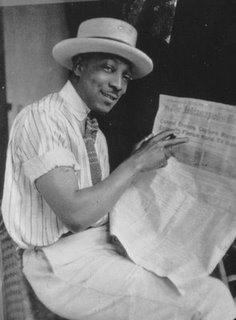
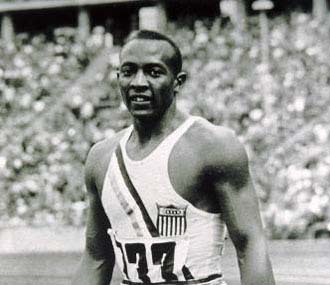
Today’s spotlight person is Jesse Owens

James Cleveland “Jesse” Owens was an American track and field athlete. The seventh child of Henry and Emma Alexander Owens was born in Alabama on September 12, 1913. “J.C.”, as he was called, was nine when the family moved to Cleveland, Ohio, where his new schoolteacher gave him the name that was to become known around the world. The teacher was told “J.C.” when she asked his name to enter in her roll book, but she thought he said “Jesse”. The name stuck and he would be known as Jesse Owens for the rest of his life.

Throughout his life Owens attributed the success of his athletic career to the encouragement of Charles Riley, his junior-high track coach at Fairmount Junior High, who had put him on the track team. Since Owens worked in a shoe repair shop after school, Riley allowed him to practice before school instead. His promising athletic career began in 1928 in Cleveland, Ohio where he set Junior High School records by clearing 6 feet in the high jump, and leaping 22 feet 11 3/4 inches in the broad jump. During his high school days, he won all of the major track events, including the Ohio state championship three consecutive years.

At the National Interscholastic meet in Chicago, during his senior year, he set a new high school world record by running the 100 yard dash in 9.4 seconds to tie the accepted world record, and he created a new high school world record in the 220 yard dash by running the distance in 20.7 seconds. A week earlier he had set a new world record in the broad jump by jumping 24 feet 11 3/4 inches. Owens’ sensational high school track career resulted in him being recruited by dozens of colleges. Owens chose the Ohio State University, even though OSU could not offer a track scholarship at the time. He worked a number of jobs to support himself and his young wife, Ruth. He worked as a night elevator operator, a waiter, he pumped gas, worked in the library stacks, and served a stint as a page in the Ohio Statehouse, all of this in between practice and record setting on the field in intercollegiate competition.

Owens’s performance at the 1936 Berlin Olympics has become legend, both for his brilliant gold-medal efforts in the 100-metre run (10.3 sec, an Olympic record), the 200-metre run (20.7 sec, a world record), the long jump (8.06 metres [26.4 feet]), and the 4 100-metre relay (39.8 sec) and for events away from the track. One popular tale that arose from Owens’s victories was that of the “snub,” the notion that Hitler refused to shake hands with Owens because he was an African American. In truth, by the second day of competition, when Owens won the 100-metre final, Hitler had decided to no longer publicly congratulate any of the athletes. The previous day the International Olympic Committee president, angry that Hitler had publicly congratulated only a few German and Finnish winners before leaving the stadium after the German competitors were eliminated from the day’s final event, insisted that the German chancellor congratulate all or none of the victors. Unaware of the situation, American papers reported the “snub,” and the myth grew over the years.

Just before the competitions Owens was visited in the Olympic village by Adi Dassler, the founder of Adidas. He persuaded Owens to use Adidas shoes and it was the first sponsorship for a male African-American athlete.

On the first day, Hitler shook hands only with the German victors and then left the stadium. Olympic committee officials then insisted Hitler greet each and every medalist or none at all. Hitler opted for the latter and skipped all further medal presentations. On reports that Hitler had deliberately avoided acknowledging his victories, and had refused to shake his hand, Owens recounted:

When I passed the Chancellor he arose, waved his hand at me, and I waved back at him. I think the writers showed bad taste in criticizing the man of the hour in Germany.

He also stated: “Hitler didn’t snub me—it was FDR who snubbed me. The president didn’t even send me a telegram.” Jesse Owens was never invited to the White House nor bestowed any honors by Presidents Franklin D. Roosevelt (FDR) or Harry S. Truman during their terms. In 1955, President Dwight D. Eisenhower acknowledged Owens’s accomplishments, naming him an “Ambassador of Sports.”

After the games had finished, Owens was invited, along with the rest of the team, to compete in Sweden. However he decided to capitalize on his success by returning to the United States to take up some of the lucrative commercial offers he was receiving. American athletic officials were furious and withdrew his amateur status, ending his career immediately. Owens was livid: “A fellow desires something for himself,” he said.

With no sporting appearances to bolster his profile, the lucrative offers never quite materialized. Instead he was forced to try to make a living as a sports promoter, essentially an entertainer. He soon found himself running a dry-cleaning business and then even working as a gas station attendant. He eventually filed for bankruptcy but, even then, his problems were not over and in 1966 he was successfully prosecuted for tax evasion. At rock bottom, the rehabilitation began and he started work as a U.S. “goodwill ambassador.”

Jesse Owens died from complications due to lung cancer on March 31, 1980 in Tucson, Arizona. Although words of sorrow, sympathy and admiration poured in from all over the world, perhaps President Carter said it best when he stated: “Perhaps no athlete better symbolized the human struggle against tyranny, poverty and racial bigotry. His personal triumphs as a world-class athlete and record holder were the prelude to a career devoted to helping others. His work with young athletes, as an unofficial ambassador overseas, and a spokesman for freedom are a rich legacy to his fellow Americans.”

Stray Toasters

Namaste.

Valentine’s Day 2010

comics and animation, dining and cuisine, engagement/wedding/marriage, everyday glory, family and friends, food for thought, games, LEGO and Rokenbok, movies and TV 1 Comment »

Sunday – 14 February 2010
Happy Valentine’s Day.

…or Single Awareness Day.
…or Anti-Green Lantern Day.

Take your pick.

SaraRules got me a two cards, LEGO Batman for the 360 and Fringe (Season 1). Of the cards, one was your standard greeting card, the other was this:
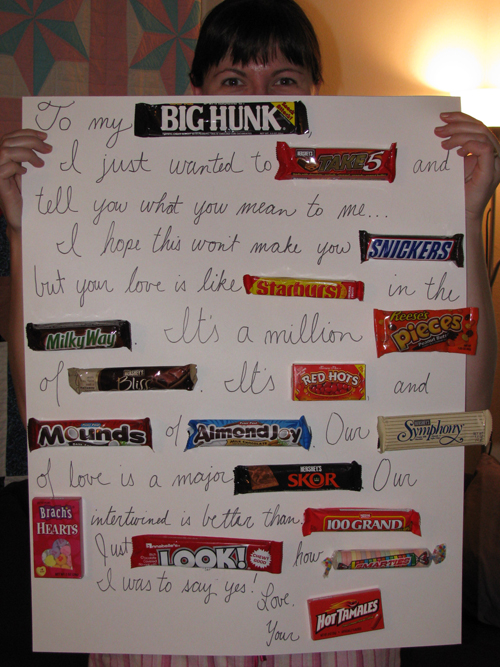
“Very sweet,” indeed.

Yesterday’s HeroClix tournament not only had a good turnout – three or four new participants and a young man who came to learn what the game was and how to play. After the game I ran up to Woods Cross to pick up one of SaraRules’ gift items:

…a cake that my friend Julie made.  (The cake ends at the bottom row of flowers, but the fondant matches the paper used on the base.) We should be tackling part of it tonight after dinner.

After picking up the cake and running a couple of other errands, I came home and had dinner with SaraRules before she headed to the symphony hall. (Yes, she had to work for a bit last night.) Shortly after she left, Darillyn and Stephanie arrived. We sat and chatted for a couple of hours until SaraRules got home; then Darillyn and Stephanie headed out to go dancing.  SaraRules and I watched Tales of the Black Freighter and Zombieland.

This morning, we all slept in. Very in. 1130 – 1200 in. And it was good. I fixed coffee; SaraRules made waffles. We sat around and ate and then showed D and S the wedding, engagement and bridal photos. After they got showered and dressed, D and S headed off for more adventures before heading back to southern Utah.

Chew on This: Food for Thought – Black History Month
Today, there will again be two entries:

The Nicholas Brothers
The Nicholas Brothers were a famous African-American team of dancing brothers, Fayard (1914–2006) and Harold Nicholas (1921–2000).

The Nicholas Brothers grew up in Philadelphia, the sons of musicians who played in their own band at the old Standard Theater He was completely fascinated by the black Vaudeville acts and imitated their acrobatics and clowning for the kids in his neighborhood. Harold watched and imitated Fayard until he was able to dance too, then apparently, he worked his own ideas into mimicry.

It seems that the Nicholas Brothers were immediately successful. Word soon spread through the city about their ingenuity and unique dancing abilities, and they were first hired for a radio program, “The Horn and Hardart Kiddie Hour”, and then by local theaters, like the Standard and the Pearl.  While at the Pearl Theater, the manager of the famous New York Vaudeville Showcase, The Lafayette, saw them. Overwhelmed by what he saw, he immediately signed them up for his theater.

From the Lafayette, the Nicolas Brothers opened at the Cotton Club  in 1932 and astonished their white audiences just as much as the residents of Harlem, slipping into their series of spins, twists, flips, and tap dancing to the jazz tempos of “Bugle Call Rag”. They were the only entertainers in the African American cast allowed to mingle with white patrons. They performed at the Cotton Club for two years, working with the orchestras of  Lucky Millinder, Cab Calloway, Duke Ellington and Jimmy Lunceford. The Nicholas Brothers then journeyed to Hollywood in 1934 to appear in the films “Kid Millions”, “The Big Broadcast” (1936), and “Black Network”.

By 1940, they were in Hollywood and for several decades alternated between movies, nightclubs, concerts, Broadway, television, and extensive tours of Latin America, Africa, and Europe.

The Nicholas Brothers taught master classes in tap dance as teachers-in-residence at Harvard University and Radcliffe as Ruth Page Visiting Artists. Among their known students are Debbie Allen, Janet Jackson, and Michael Jackson. Several of today’s master tap dancers have performed with or been taught by the brothers.

N.A.A.C.P.
The National Association for the Advancement of Colored People (N.A.A.C.P.) is one of the oldest and most influential civil rights organizations in the United States.

The NAACP is the nation’s oldest, largest and most widely recognized grassroots–based civil rights organization. Its mission is “to ensure the political, educational, social, and economic equality of rights of all persons and to eliminate racial hatred and racial discrimination”. The organization was founded on February 12, 1909 by a diverse group composed of W.E.B. Du Bois, Ida B. Wells, Archibald Grimké, Henry Moscowitz, Mary White Ovington, Oswald Garrison Villard, William English Walling (the last son of a former slave-holding family), and Florence Kelley, a social reformer and friend of Du Bois.

The Race Riot of 1908 in Lincoln’s hometown of Springfield, Illinois had highlighted the urgent need for an effective civil rights organization in the U.S. This event is often cited as the catalyst for the formation of the NAACP. Mary White Ovington, journalist William English Walling and Henry Moscowitz met in New York City in January 1909 and the NAACP was born. Solicitations for support went out to more than 60 prominent Americans, and a meeting date was set for February 12, 1909. This was intended to coincide with the 100th anniversary of the birth of President Abraham Lincoln, who emancipated enslaved African Americans. While the meeting did not take place until three months later, this date is often cited as the founding date of the organization.

The NAACP’s headquarters are in Baltimore, Maryland, with additional regional offices in California, New York, Michigan, Missouri, Georgia and Texas. Each regional office is responsible for coordinating the efforts of state conferences in the states included in that region. Local, youth, and college chapters organize activities for individual members. The NAACP is run nationally by a 64-member board led by a chair. The board elects one person as the President and chief executive officer for the organization.

Its more than half-million members and supporters throughout the United States and the world are the premier advocates for civil rights in their communities, conducting voter mobilization and monitoring equal opportunity in the public and private sectors.

Stray Toasters

  • SaraRules and I are continuing our nominal tradition of eating dinner at Brazilian steakhouses on Valentine’s Day with a trip to Rodizio Grill.
  • I’ve missed doing Four-Color Coverage over the past few months, but haven’t wanted to load up Random Access with all of my rants and raves about comics and all things comic-related. So, last night, I finally came up with solution: Four-Color Coverage.
  • In setting up the new blog for FCC, I placed a call to my hosting provider, Powweb. I’ve been with them for… five or six years, I believe. I wanted to verify a pricing and data plan issue that I didn’t quite grok.  The CSR explained where I had misunderstood something in the setup and was quite helpful in making sure that I was satisfied with my service… even to the point of offering to change my payment plan, if necessary.  I assured him that it wasn’t necessary, but appreciated the willingness to go that extra mile. If you’re looking for a decently-priced host with good features, give them a look.

Time to head to dinner!

Namaste.

Rainy Saturday in the valley

arts and leisure, everyday glory, family and friends, food for thought, games, movies and TV, news and info, The Covet List No Comments »

Saturday – 13 February 2010
Saturday. Thank Heaven.

This morning, I’m heading off to run another tournament in a bit. But, first… coffee with Chris and Perry.

Chew on This: Food for Thought – Black History Month
Today’s spotlighted person is: Hattie McDaniel

Hattie McDaniel was born June 10, 1895, in Wichita, Kansas, to former slaves. She was the youngest of 13 children. In 1900, the family moved to Colorado, living first in Fort Collins and then in Denver, where Hattie grew up and graduated from Denver East High School.

In addition to performing, Hattie was also a songwriter, a skill she honed while working with her father’s minstrel show. After the death of her brother Otis in 1916, the troupe began to lose money, and it wasn’t until 1920 that Hattie received another big opportunity. During 1920–25, she appeared with Professor George Morrison’s Melony Hounds, a touring black ensemble, and in the mid-1920s she embarked on a radio career, singing with the Melony Hounds on station KOA in Denver. In 1927–1929 she also recorded many of her songs on Okeh Records and Paramount Records in Chicago.

Two years after McDaniel’s film debut in 1932, she landed her first major part in John Ford’s Judge Priest (1934), in which she had an opportunity to sing a duet with humorist Will Rogers. Her role as a happy Southern servant in The Little Colonel (1935) made her a controversial figure in the liberal black community, which sought to end Hollywood’s stereotyping. When criticized for taking such roles, McDaniel responded that she would rather play a maid in the movies than be one in real life; and during the 1930s she played the role of maid or cook in nearly 40 films, including Alice Adams (1935), in which her comic characterization of a grumbling, far-from-submissive maid made the dinner party scene one of the best remembered from the film. She is probably most often associated with the supporting role of Mammy in the 1939 film Gone with the Wind, a role for which she became the first African American to win an Academy Award.

It was her role as the sassy servant who repeatedly scolds her mistress, Scarlett O’Hara (Vivien Leigh), and scoffs at Rhett Butler (Clark Gable), that won McDaniel the 1940 Academy Award for Best Supporting Actress, making her the first African American to win an Oscar. She was also the first African American ever to be nominated. “I loved Mammy,” McDaniel said. “I think I understood her because my own grandmother worked on a plantation not unlike Tara.” Her role in Gone with the Wind had scared some in the Southern audience; there were complaints that in the film she had been too familiar with her white employer.

At the end of World War II, during which McDaniel organized entertainment for black troops, the NAACP (National Association for the Advancement of Colored People) and other liberal black groups lobbied Hollywood for an end to the stereotyped roles in which McDaniel had become typecast, and consequently her Hollywood opportunities declined. Radio, however, was slower to respond, and in 1947 she became the first African American to star in a weekly radio program aimed at a general audience when she agreed to play the role of a maid on The Beulah Show. In 1951, while filming the first six segments of a television version of the popular show, she had a heart attack. She recovered sufficiently to tape a number of radio shows in 1952 but died soon thereafter of breast cancer.

McDaniel has two stars on the Hollywood Walk of Fame in Hollywood: one for her contributions to radio at 6933 Hollywood Boulevard, and one for motion pictures at 1719 Vine Street. In 1975, she was inducted into the Black Filmmakers Hall of Fame and in 2006 became the first black Oscar winner honored with a US postage stamp.

Stray Toasters

I may do more later. Right now, I’ve got to get ready to get my game on!

Namaste.
“Believe it or not, it’s just me…”

comics and animation, dining and cuisine, everyday glory, family and friends, food for thought, games, geekery, movies and TV, music, news and info, office antics, science and technology, style, Whiskey Tango Foxtrot...?!, workout 1 Comment »

Friday – 12 February 2010
Thank God it’s Friday… even if it’s my “on” Friday. For some reason, I woke up with Rockapella’s Daisy Simone running through my head. It wasn’t a problem, just really an unexpected selection.

Tonight, Darillyn and Stephanie(2) are coming up for a couple of days.  We haven’t seen D since the wedding; and I don’t think that I’ve seen Steph2 since SaraRules lived in Cedar City. It should be a good weekend.

Last night, SaraRules fixed a Thai shrimp curry. It was very tasty. Three guesses what I have for lunch today.

Chew on This: Food for Thought – Black History Month
Today’s spotlight person is: Spike Lee

Shelton Jackson “Spike” Lee is an American film director, producer, writer, and actor. He was born in Atlanta, but moved with his family to Brooklyn, New York when he was a small child. Lee enrolled in Morehouse College where he made his first student film, Last Hustle in Brooklyn. He took film courses at Clark Atlanta University and graduated with a B.A. in Mass Communication from Morehouse College. He then enrolled in New York University’s Tisch School of the Arts. He graduated in 1978 with a Master of Fine Arts in Film & Television.

Lee became a director of promise with his first feature film, She’s Gotta Have It, in 1986. The film was shot in two weeks on a budget of $160,000 and grossed over $700,000 in the U.S.  (The reception of She’s Gotta Have It led Lee down a second career avenue. Marketing executives from Nike offered Lee a job directing commercials for the company. They wanted to pair Lee’s character from She’s Gotta Have It, the Michael Jordan-loving Mars Blackmon, and Jordan himself in their marketing campaign for the Air Jordan line.)

Lee often takes a critical look at race relations, political issues and urban crime and violence. His next film, 1989’s Do The Right Thing examined all of the above and was nominated for an Academy Award for Best Original Screenplay in 1989. Subsequent films, including Malcolm X, Mo’ Better Blues, Summer of Sam and She Hate Me, continued to explore social and political issues. 4 Little Girls, a piece about the 1963 16th Street Baptist Church bombing, was nominated for an Academy Award for Best Feature Documentary in 1997.

In 2006, Lee directed and produced a four-hour documentary for television, When the Levees Broke: A Requiem in Four Acts, about life in New Orleans in the aftermath of Hurricane Katrina.

His most recent feature film release, Miracle at St. Anna (2008), tells the story of four African American soldiers trapped in an Italian village during World War II. This movie was praised for bringing the often overlooked experience of black infantrymen — known as buffalo soldiers — to the big screen.

Lee has never shied away from controversial statements and actions involving race relations:

  • In 2002, after headline-grabbing remarks made by Mississippi Senator Trent Lott regarding Senator Strom Thurmond’s failed presidential bid, Lee charged that Lott was a “card-carrying member of the Ku Klux Klan” on ABC’s Good Morning America.
  • After the 1990 release of Mo’ Better Blues, Lee was accused of antisemitism by the Anti-Defamation League and several film critics.
  • Lee was the executive producer of the 1995 film New Jersey Drive, which depicted young African-American auto thieves in northern New Jersey.
  • In May 1999 The New York Post reported that Lee said of National Rifle Association President Charlton Heston, “Shoot him with a .44 Bulldog.” Lee contended, “I intended it as ironic, as a joke to show how violence begets more violence,” Lee said.
  • In 2003, Lee filed suit against the Spike TV television network claiming that they were capitalizing on his fame by using his name for their network. The injunction order filed by Spike Lee was eventually lifted.
  • In October 2005, Lee commented on the federal government’s response to the 2005 Hurricane Katrina catastrophe:

    “It’s not too far-fetched. I don’t put anything past the United States government. I don’t find it too far-fetched that they tried to displace all the black people out of New Orleans.”

  • Lee sparked controversy on a March 28, 2004 segment on ABC when he said that basketball player Larry Bird was overrated because of his race:

    “The most overrated player of all time, I would say it’d be Larry Bird. Now, Larry Bird is one of the greatest players of all time, but listen to the white media, it’s like this guy was like nobody ever played basketball before him–Larry Bird, Larry Bird, Larry Bird, Larry Bird, Larry Bird.”

  • At the 2008 Cannes Film Festival, Lee, who was then making Miracle at St. Anna, about an all-black U.S. division fighting in Italy during World War II, criticized director Clint Eastwood for not depicting black Marines in his own WWII film, Flags of Our Fathers.
  • During a lecture at Concordia University in Montreal, Canada on February 11, 2009, Lee criticized how some in the black community wrongfully associate “intelligence with acting white, and ignorance with acting black”, admonishing students and parents to maintain more positive attitudes in order to follow their dreams and achieving their goals.

Lee’s production company, 40 Acres & A Mule Filmworks, is located in his childhood neighborhood of Fort Green in Brooklyn.

Workout
Yesterday, Wes and I made an attempt at getting back into the swing of things at the gym. And guess who did his first 300 pound bench press of the year! Mm-hmm, that’s right. Me. Sho’nuff!

  • Elliptical: random/8 minutes
  • Sit-ups (incline): 3 sets/20 reps
  • Reverse Punches: 2 sets/10 reps, 10 lbs
  • Bench Press: 1 set/1 rep, 300 lbs (!)
  • Bench Press: 3 sets/8 reps, 205 lbs
  • Flys: 3 sets/10 reps, 110 lbs
  • Shoulder Press: 3 sets/10 reps, 60 lbs

Post-workout weight (in gym clothes): 189.8 lbs

Stray Toasters

Namaste.